RAG Explained Without the Jargon
Retrieval-Augmented Generation sounds complicated. The actual concept is surprisingly simple — and it's behind most useful AI applications.

Executive Summary · In 30 Seconds
- RAG (Retrieval-Augmented Generation) grounds LLMs with private, up-to-date data without requiring expensive model fine-tuning.
- The process involves chunking source documents, storing semantic embeddings in a vector database, and injecting matching context into prompts.
- The bottleneck is rarely the language model itself, but rather the quality of chunking, indexing, and hybrid search re-ranking.
- RAG can reduce unsupported answers, but retrieval errors and incorrect interpretation remain possible.
On this page
In one sentence
RAG is a way to give an AI model access to information it didn't have when it was trained.
That's it. Everything else is implementation detail.
Why it exists
Language models like GPT-4 or Claude are trained on a snapshot of the internet. They know a lot, but they don't know:
- What happened after their training cutoff
- Your company's internal documents
- Your personal notes and files
- Anything that wasn't publicly available during training
RAG solves this by letting the model look things up before answering.
How it works
Think of it like an open-book exam versus a closed-book exam.
Without RAG (closed-book): You ask the AI a question. It answers based entirely on what it learned during training. If the answer requires information it doesn't have, it either says "I don't know" or makes something up.
With RAG (open-book): You ask the AI a question. Before answering, it searches through a collection of documents to find relevant information. Then it uses that information to construct its answer.
The process has three steps:
- Retrieve — search for relevant documents based on the question
- Augment — add those documents to the AI's context
- Generate — the AI answers using both its training and the retrieved documents
A real example
Say you're building a customer support chatbot for a software company. The company has:
- 500 help articles
- 200 pages of documentation
- 50 FAQ pages
Without RAG, the chatbot can only give generic answers. With RAG, when a customer asks "How do I reset my API key?", the system:
- Searches the documentation and finds the relevant article
- Passes that article to the language model
- The model generates a specific, accurate answer based on the real documentation
Why not just put everything in the prompt?
Language models have a limited context window — the amount of text they can process at once. Even with today's large context windows (up to 200K tokens for some models), you can't fit 500 help articles into a single prompt.
RAG solves this by only retrieving the 3-5 most relevant documents for each question. This is faster, cheaper, and often more accurate than dumping everything into the context.
The limitations
RAG is powerful but not perfect:
Retrieval quality matters. If the search step returns irrelevant documents, the AI will generate irrelevant answers. Garbage in, garbage out.
It doesn't understand. RAG helps the AI access information, but the AI still needs to reason about it correctly. If the retrieved documents are ambiguous or contradictory, the AI might get confused.
It requires maintenance. Your document collection needs to be kept up-to-date. If the help articles are outdated, the AI will give outdated answers.
Where you've already seen it
If you've used any of these, you've used RAG:
- Perplexity — searches the web and uses results to answer questions
- ChatGPT with browsing — retrieves web pages before responding
- GitHub Copilot — retrieves relevant code files from your project
- NotebookLM — searches your uploaded documents
The technology behind them varies, but the core concept is the same: retrieve, augment, generate.
Why it matters
RAG is what makes AI actually useful for specific domains. Without it, language models are impressive but generic. With it, they can be genuinely useful for your particular situation, your documents, and your questions.
It's not magic. It's an open-book exam. And that's exactly what makes it work.
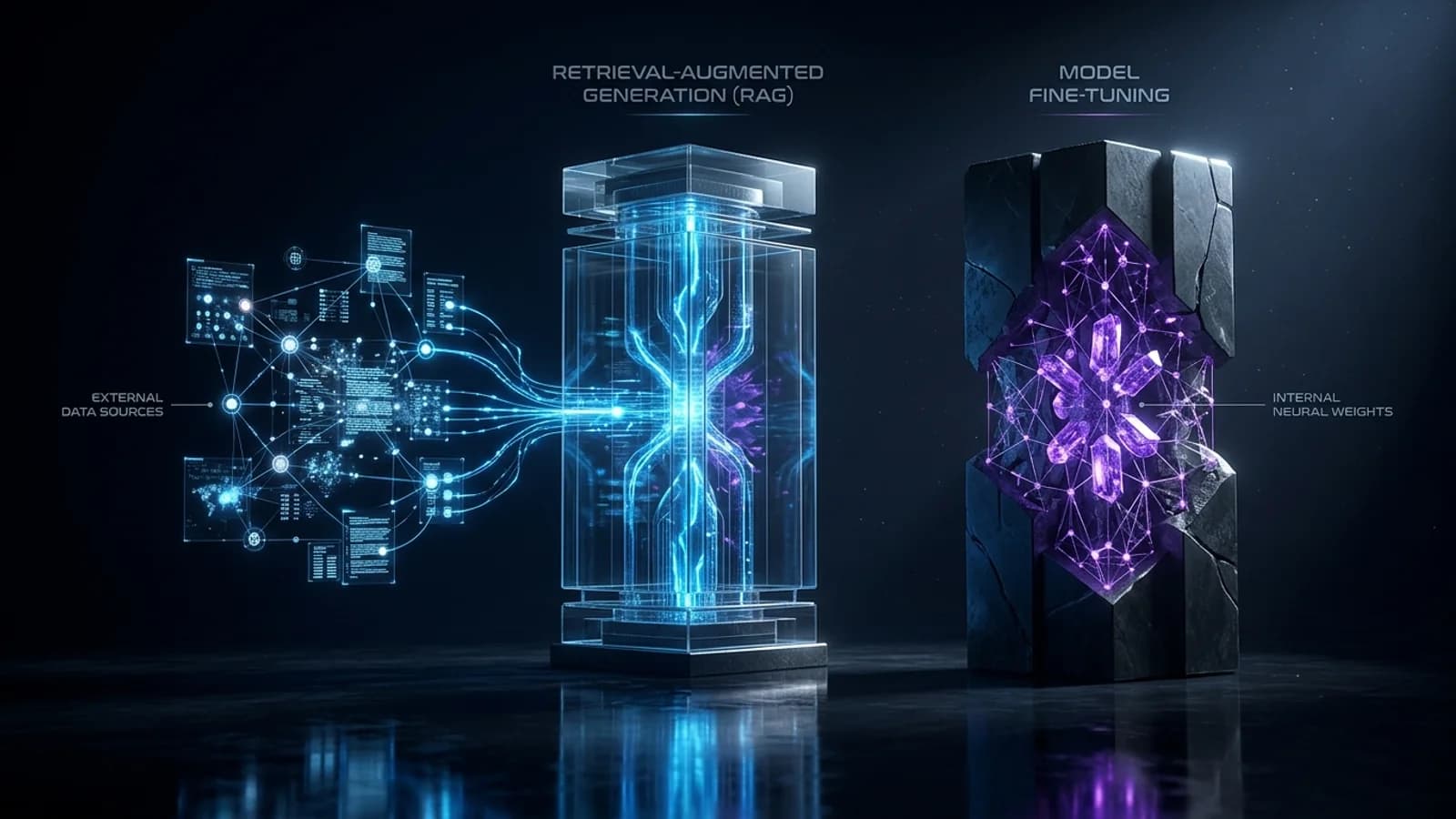
If you're choosing an architecture for a project, our RAG versus fine-tuning guide explains how to distinguish missing information from inconsistent model behavior.
Common Questions & Practical Answers
RAG stands for Retrieval-Augmented Generation. It is a system architecture that pairs a retrieval mechanism (vector database or hybrid search) with a generative language model to provide accurate, grounded answers from custom documents.

Editorial contributor covering foundational AI models, agentic workflows, and systems engineering for Lucivo.
Related articles
RAG vs Fine-Tuning: Which Does Your AI Project Actually Need?

What Is an AI Agent, Really?
How to Check AI Hallucinations Before You Trust an Answer
The Weekly Breakdown
High signal AI & software stories.
Direct to your inbox. No hype.
Independent analysis of AI models, developer tools, and computing architectures. Delivered every Sunday morning. 100% free.